Evolvable Embodied Agent for Robotic Manipulation via Long Short-Term Reflection and Optimization
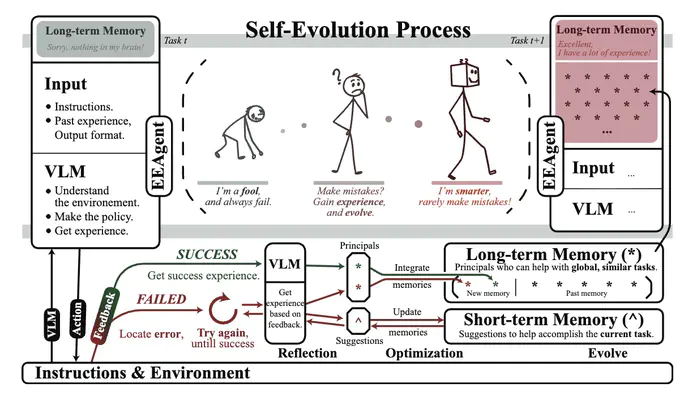 The motivation for introducing EEAgent
Abstract
Achieving general-purpose robotics requires empowering robots to adapt and evolve based on their environment and feedback. Traditional methods face limitations such as extensive training requirements, difficulties in cross-task generalization, and lack of interpretability. Prompt learning offers new opportunities for self-evolving robots without extensive training, but simply reflecting on past experiences. However, extracting meaningful insights from task successes and failures remains a challenge. To this end, we propose the evolvable embodied agent (EEAgent) framework, which leverages large visionlanguage models (VLMs) for better environmental interpretation and policy planning. To enhance reflection on past experiences, we propose a long short-term reflective optimization (LSTRO) mechanism that dynamically refines prompts based on both past experiences and newly learned lessons, facilitating continuous self-evolution, thereby enhancing overall task success rates. Evaluations on six VIMA-Bench tasks reveal that our approach sets a new state-of-the-art, notably outperforming baselines in complex scenarios.


Botao Zhao
Researcher

Yayun He
Researcher